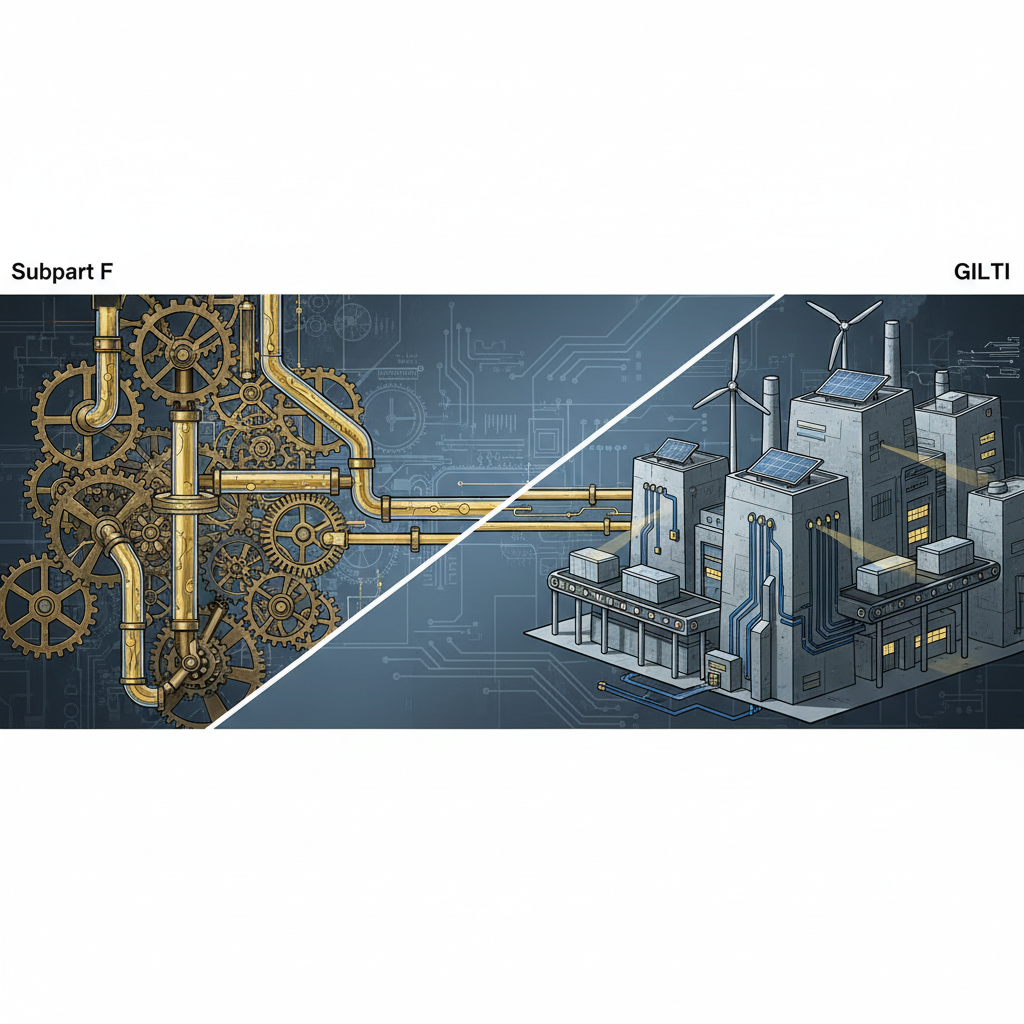
The Coexistence of Subpart F and GILTI: Analyzing U.S. International Taxation for CFC Shareholders
A comprehensive analysis of the interaction between Subpart F and the GILTI regime, highlighting the mutual exclusion of income, the disparate impact on corporate versus individual shareholders, and compliance challenges in the new global tax landscape.
Introduction and Historical Context
The United States international tax system balances the global competitiveness of its enterprises with the protection of its domestic tax base through the regime applicable to Controlled Foreign Corporations (CFCs). Prior to the introduction of corrective measures, U.S. taxpayers were able to accumulate income in low-tax jurisdictions, indefinitely postponing federal taxation until those funds were repatriated as dividends. To counter this practice, the U.S. Congress introduced the Subpart F regime in 1962 under the administration of President John F. Kennedy. This regulatory framework marked a milestone by restricting tax deferral for certain categories of mobile and passive income, treating them as deemed distributions to domestic shareholders.
The landscape changed drastically in 2017 with the enactment of the Tax Cuts and Jobs Act (TCJA). This tax reform reconfigured the U.S. international tax system by transitioning toward a modified territorial model. To prevent active income that did not fit the strict definition of Subpart F from eroding the domestic tax base, the TCJA introduced the Global Intangible Low-Taxed Income (GILTI) regime under Section 951A of the Internal Revenue Code (IRC). Since then, U.S. shareholders of CFCs must navigate an intricate two-track system where two international tax transparency regimes coexist, operating under substantially different rules and objectives.
The Subpart F Regime: The Bastion Against Passive Income Deferral
The Subpart F regime focuses primarily on preventing taxpayers from shifting easily movable income to jurisdictions with preferential tax regimes. This regime is triggered when a foreign corporation qualifies as a CFC, which occurs if more than 50% of its total voting power or value is owned by U.S. Shareholders, defined as U.S. persons or entities who each own at least 10% of the voting power or value of the foreign entity.
Income subject to Subpart F, detailed in Section 952 of the IRC, includes primarily Foreign Base Company Income, which encompasses dividends, interest, royalties, rents, and gains from the sale of assets that generate such passive income. The legislation seeks to neutralize the tax benefit of these structures by requiring U.S. shareholders to include in their current income tax returns their pro rata share of the CFC's undistributed earnings. This tax transparency mechanism ensures that passive income is taxed immediately at the applicable U.S. rate, regardless of whether the funds remain abroad.
The Advent of GILTI: Capturing Global Low-Taxed Active Income
The GILTI regime, codified in Section 951A, complements Subpart F by expanding the scope of immediate taxation to active income earned by CFCs. Despite its name, GILTI is not limited to income derived from intangible assets such as patents or trademarks; in practice, it functions as a minimum tax on the excess global operating yield of a CFC.
The calculation of GILTI is based on a formula that determines the CFC's "net tested income" and subtracts an exempt ordinary return. This exempt return is fixed by law at 10% of the net book value of depreciable tangible assets used in the corporation's trade or business, a concept known as Qualified Business Asset Investment (QBAI). Any net operating profit exceeding this 10% QBAI threshold is classified as GILTI and included in the U.S. shareholder's current taxable income. Thus, operations relying heavily on tangible capital enjoy a partial exclusion, while service-oriented, technology, or high-margin activities are heavily impacted by this tax.
The Critical Interplay and Mutual Exclusion Rule
A major concern for tax advisors and taxpayers is the risk of economic double taxation under both regimes on the same stream of income. Fortunately, the legislative design of the IRC establishes a clear mutual exclusion rule: income that has already been classified and taxed under Subpart F is automatically excluded from the calculation of "gross tested income" for GILTI purposes.
This priority of Subpart F ensures that both taxes do not accumulate on the same dollar of profit. However, this interaction requires a meticulous process of income characterization and segregation at the CFC level. Businesses must analyze each stream of income to determine if it qualifies as Subpart F; if so, it is included directly under Section 951(a)(1)(A). The remaining active income of the CFC is then subjected to the GILTI calculation under Section 951A. This operational sequence highlights the importance of rigorous analytical accounting, as an error in classification can significantly alter the group's consolidated tax burden.
The Gap Between Individual and Corporate Shareholders: The Section 962 Lifeline
The impact of GILTI and Subpart F varies drastically depending on the legal nature of the U.S. shareholder. U.S. tax legislation grants preferential treatment to domestic corporations (C corporations) compared to individuals, trusts, or partnerships.
U.S. corporations subject to GILTI can benefit from two fundamental tax mitigation mechanisms:
- The Section 250 deduction, which allows a 50% reduction in the GILTI taxable base, resulting in a federal effective tax rate of 10.5% (compared to the general corporate rate of 21%). It is important to note that this 10.5% rate is scheduled to increase to 13.125% for taxable years beginning after December 31, 2025, due to the statutory reduction of the Section 250 deduction to 37.5% (unless Congress approves an extension of the TCJA benefits). Furthermore, there are active legislative proposals in the administration's Fiscal Year 2025 Greenbook to reform the GILTI regime more aggressively, substantially increasing its tax rate and eliminating the QBAI exemption.
- Access to indirect foreign tax credits under Section 960, allowing up to 80% of the income taxes paid by the CFC abroad to be credited against the U.S. tax liability generated by GILTI.
Conversely, individual shareholders do not have automatic access to these benefits. Without proper planning, a U.S. individual owning a CFC with income subject to GILTI will be taxed at ordinary individual rates (which can reach 37%) on 100% of the imputed income, with no option to apply the 50% deduction or to credit the corporate taxes paid abroad. This asymmetry can result in confiscatory combined tax rates.
To level the playing field, individual shareholders can utilize an election under Section 962 of the IRC. This provision allows an individual to elect to be treated as a domestic corporation solely for the purposes of Subpart F and GILTI inclusions. By making this annual election, the individual can claim the Section 250 deduction and Section 960 indirect foreign tax credits, substantially reducing their immediate tax burden. However, Section 962 introduces an additional layer of complexity and a deferred cost: under Section 962(d), the subsequent actual distribution of dividends by the CFC will be subject to a second level of ordinary taxation in the U.S., allowing only a deduction for the federal tax already paid under the election. It is crucial to warn that this election is primarily a deferral strategy and that the subsequent distribution of previously taxed earnings (PTE) loses the benefit of qualified dividend rates (maximum 20%), being taxed at ordinary rates of up to 37%, which can result in a confiscatory combined rate. Consequently, this option is generally efficient only if the funds are to be reinvested indefinitely outside the U.S., necessitating a rigorous cost-benefit analysis before making the election.
The High-Tax Exclusion and Its Operational Challenges
In 2019, the Treasury Department and the IRS issued final regulations introducing the high-tax exclusion (HTE) for both Subpart F and GILTI. This rule allows taxpayers to exclude from their taxable income in the U.S. those CFC earnings that were subject to an effective foreign tax rate higher than 90% of the maximum U.S. corporate tax rate (currently 18.9%, calculated as 90% of 21%).
While the HTE represents significant relief for operations in high-tax jurisdictions, its practical application is highly complex. The calculation of the effective foreign tax rate is not performed on a consolidated CFC basis, but rather on the basis of "testing units." A single CFC may have multiple testing units, such as foreign branches, hybrid entities, or the home office itself, and income and expenses must be meticulously allocated to each under Section 904 rules. If a testing unit exceeds the 18.9% threshold, its income can be excluded from GILTI, but the taxpayer must make a formal election that binds all CFCs in the group under a consistency standard.
Concurrent Regimes and Global Standards
The Boundary Between Regimes: CFC vs. PFIC
The Controlled Foreign Corporation (CFC) regime, which encompasses Subpart F and GILTI, is legally distinct from and must not be confused with the Passive Foreign Investment Company (PFIC) rules. While CFC status is based on concentrated control by significant U.S. shareholders (more than 50% ownership by 10% shareholders), the PFIC regime applies to any foreign corporation meeting passive income or asset tests (75% or more passive income or 50% or more passive assets), regardless of the level of U.S. control. PFICs impose severe deferral penalties through excess distribution rules unless specific elections, such as the Qualified Electing Fund (QEF) election, are made. Crucially, as a general rule, under the overlap rule of IRC Section 1297(d), if an entity qualifies simultaneously as a CFC and a PFIC for a U.S. shareholder, the CFC rules take priority, suspending the application of the PFIC regime to avoid regulatory overlap.
The Interaction with the Multilateral Pillar Two Standard
On the other hand, the international tax landscape is being redefined by the OECD's multilateral standard known as Pillar Two (GloBE rules), which seeks to establish a 15% global minimum tax for multinational groups with consolidated revenues exceeding 750 million euros. Although GILTI and Pillar Two share the goal of combating tax base erosion, they operate independently. GILTI is a unilateral U.S. rule applicable to CFCs without a minimum group revenue threshold, while Pillar Two is a multilateral framework. The interaction between the two generates complex tensions, especially since the U.S. Congress has not formally reformed the GILTI rate to align directly with the 15% Pillar Two rate. Under the priority rules of Pillar Two, foreign Qualified Domestic Minimum Top-up Taxes (QDMTTs) apply with priority over GILTI, which reduces the net taxable base or absorbs the U.S. foreign tax credit capacity, primarily harming the U.S. treasury by neutralizing its tax collection, forcing multinationals to model double taxation and cross-crediting scenarios.
Comparative Differences Table
| Feature | CFC Regime (Subpart F and GILTI) | PFIC Regime (Passive Foreign Investment Company) | OECD Pillar Two GloBE Rules |
|---|---|---|---|
| Primary Focus | Tax transparency for passive (Subpart F) and low-tax active (GILTI) income of controlled subsidiaries. | Penalizing tax deferral on passive foreign portfolio investments. | 15% global minimum tax to prevent harmful international tax competition. |
| Control Threshold | Requires >50% of vote or value to be owned by U.S. shareholders with at least 10% each. | No U.S. control threshold required; applies to any level of participation. | Applies to multinational groups with consolidated revenues exceeding 750 million euros. |
| Taxation Mechanism | Current inclusion of income in the U.S. shareholder's annual tax return. | Tax on excess distributions with interest charges, or QEF / Mark-to-Market elections. | Top-up tax collected through local IIR, UTPR, or QDMTT rules. |
| Regulatory Nature | Unilateral United States legislation (Internal Revenue Code). | Unilateral United States legislation (Internal Revenue Code). | Multilateral standard coordinated and implemented by participating jurisdictions. |
Practical Implications for Cross-Border Structures (including UAE)
Structuring international business requires a detailed evaluation of these rules, especially when involving jurisdictions with evolving tax regimes. A clear example is the United Arab Emirates (UAE). Traditionally considered a zero-tax environment, the UAE has recently implemented a 9% federal corporate tax and has repealed the historical Economic Substance Regulations (ESR) regime for recent fiscal years, in accordance with Cabinet Decision 98/2024.
Any U.S. CFC established in the UAE must evaluate its status under the UAE Corporate Tax. With the suspension of ESR reporting obligations to avoid duplication of requirements, the new substance rules under the UAE Corporate Tax do not apply generally, but are strictly limited to free zone entities that intend to qualify as Qualifying Free Zone Persons (QFZPs) to access the 0% rate. Although the suspension of the ESR aims to eliminate duplicate reporting, onshore CFCs subject to the general 9% rate remain subject to rigorous economic substance standards implicit in the Transfer Pricing rules and the General Anti-Abuse Rule (GAAR) of the UAE Corporate Tax. Since the general corporate tax rate in the UAE is 9% and that of QFZPs is 0%, both rates fall well below the 18.9% threshold required for the U.S. high-tax exclusion (HTE). Consequently, UAE CFCs cannot qualify for the HTE, regardless of their level of local economic substance, unless they are subject to additional taxes in other jurisdictions that raise the effective tax rate above that limit. This will result in immediate U.S. taxation on the income generated in the Gulf if not properly planned. This demonstrates that modern tax planning cannot be performed in isolation; it must coherently integrate the local laws of the CFC's jurisdiction with the complex transparency provisions of the U.S. system.
Conclusion
The coexistence of Subpart F and GILTI requires U.S. shareholders of foreign corporations to adopt a proactive and technically rigorous approach. The dividing line between passive and active income, the calculation of QBAI, the strategic use of the Section 962 election for individuals, and the correct application of the high-tax exclusion are critical elements that determine the success or failure of an international structure. In a global environment characterized by the digitalization of the economy and the pressure for a global minimum tax, understanding these dynamics is indispensable for mitigating risks and optimizing corporate and personal tax burdens.
Disclaimer: The content of this article is presented for informational and educational purposes only and should not be construed as legal, tax, or financial advice. Tax laws and regulations are subject to constant change, and their application can vary based on the specific circumstances of each taxpayer. It is recommended to consult with a qualified tax advisor before making any decisions based on this information.
Sources
- U.S. Internal Revenue Service (IRS): Guidance on GILTI under Section 951A
- U.S. Internal Revenue Service (IRS): International Practice Unit on Subpart F
- U.S. Department of the Treasury: General Explanations of the Administration's Revenue Proposals (Greenbook FY2025)
- Organisation for Economic Co-operation and Development (OECD): Economic Impact Assessment of the Global Minimum Tax
- U.S. Securities and Exchange Commission (SEC): Tax Opinion on Subpart F and RICs